A Discipleship Chorus
[THE RECEPTION]:
I have tasted the Light, Grace of the Living Son of God,
and my heart is full, my heart is full.
[THE TRANSFORMATION]:
His truth rises in me like the morning sun,
and it calls me to move, oh, it calls me to move.
[THE CONSECRATION]:
I will dance before the Lord with all the life He's given me.
I'll use these hands to bear His light.
[THE TESTIMONY]:
Now I'm reborn, now I'm free.
SPOKEN WORD PERFORMANCE
I Have Tasted the Light
A poetic reading of the Discipleship Chorus
I was standing at the edge of something when the questions finally stopped.
Not answered. Stopped. Like a wind that's been howling so long you forgot what silence sounds like. And then it stops.
And the silence wasn't empty. It was full of everything I'd been too loud to hear.
I had nothing left to offer. No arguments. No conditions. No backup plan. Just a willingness— finally— to fall.
And the arms that caught me whispered something I'd been running from my whole life:
Child—this is what I made you for.
I used to think that faith meant certainty. That if I could know enough, understand enough, build a wall of evidence high enough— I'd be safe.
But even the demons believe. James tells us that. Even the demons believe, and they tremble at the truth.
So what was I doing that was any different?
It wasn't facts that finally freed me. It was falling to my knees. It was opening these hands I'd clenched so tight the knuckles had gone white. And letting myself breathe.
What I thought was strength was prison. What I thought was loss is gain. Every wall I built for safety was the architecture of my chains.
I have tasted the Light.
Grace of the Living Son of God.
The world looks the same this morning. Same sun. Same street. Same cracks in the sidewalk. But I swear—these eyes are new.
Something ancient woke inside me. Something that was always there but sleeping— buried under all my noise, all my striving, all my desperate, grasping need to be right.
Something deathless. Something true.
And how do I explain that? How do I explain this healing to a heart that's never broke?
You can't describe water to someone who's never been thirsty. You can't describe home to someone who's never been lost.
But the ones who've tasted— they know.
The Spirit witnessed.
Now I know.
His truth rises within me like the morning sun. Not an argument. Not a proof. A sunrise. You don't argue with the sunrise. You don't need evidence that morning has come. You just open your eyes, and there it is.
And it calls me to move.
Do you hear that? It CALLS me to move!
I will dance before the Lord with all the life He's given me. I'll use these hands— these hands that were clenched, these hands that were fists, these hands that held onto everything because I was terrified of letting go—
I'll use these hands to bear His light.
Because His mercy wore me down! Not like a storm wears down a cliff— like a river wears down a stone. Patient. Relentless. Kind.
He didn't break down my door. He knocked. And knocked. And knocked. Until the day I finally opened it and realized He'd been standing there the whole time.
Now I'm reborn. Now I'm FREE.
I have tasted the Light!
And my heart is full.
My heart is full.
Like the woman at the well, I ran to tell what I had found.
Not because my life was perfect— not because I had it figured out— because His mercy wore me down and I couldn't keep it to myself.
That's what testimony does. It doesn't wait until you're ready. It doesn't wait until you're worthy. It pours out of you the way water pours out of a spring— not because it's trying to go anywhere, but because that's what springs do.
We are not called to walk in silence. We are not called to walk alone. There is a family. There is a table. There is a testimony. There is a home.
When the shadows press their questions— and they will— when the old doubts come clawing back— and they will—
I return to the moment when He spoke and night became day.
What witness could be greater than the peace He put in me?
So I choose to remember. And the Light comes back. It always comes back.
Come unto Him. Learn of Him. Believe in Him. Follow Him. Remember Him.
I have tasted the Light.
In the name of Jesus Christ. Amen.
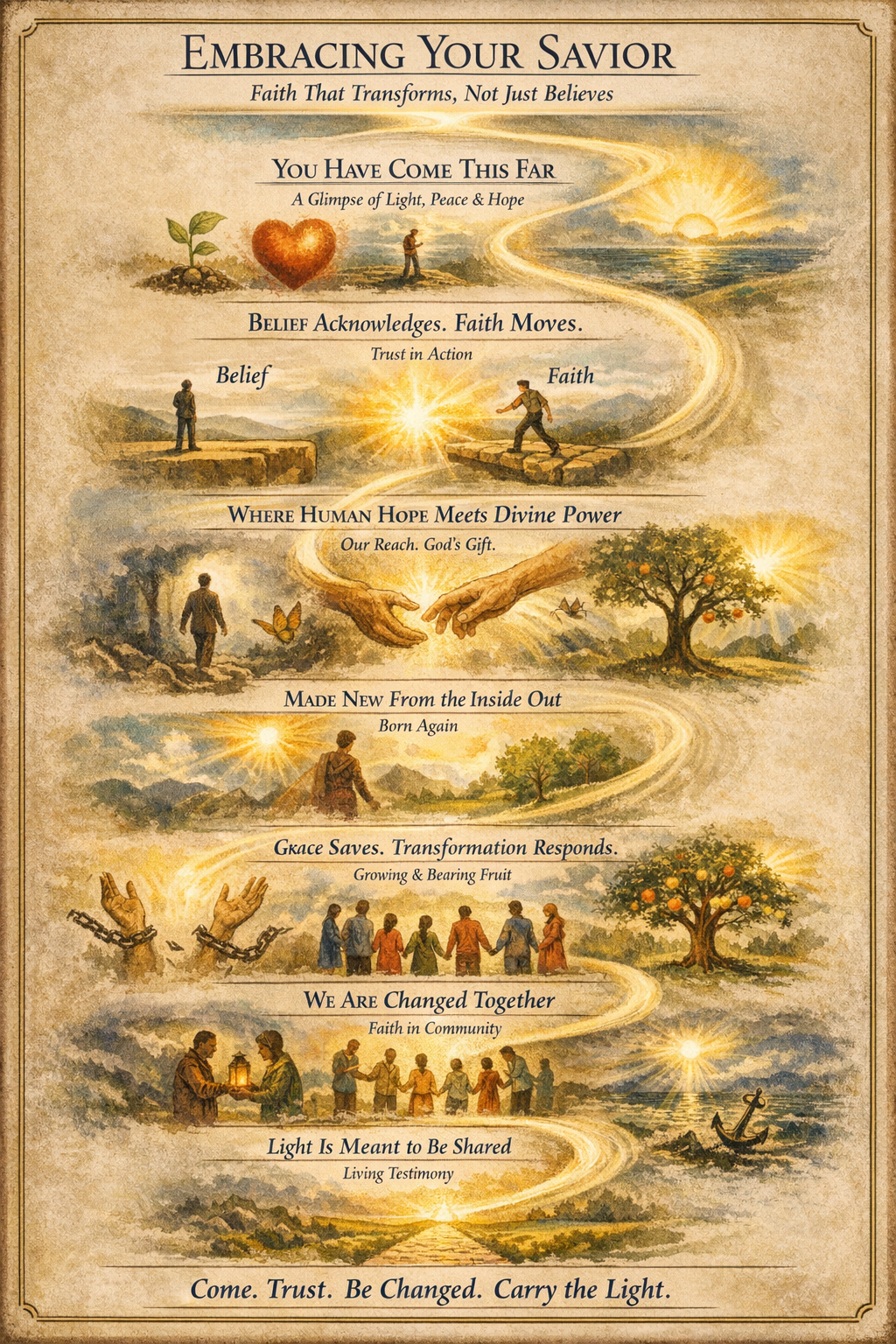
You Have Come This Far on the Journey
If you have made it to this chapter, then you have searched in plainness. You have asked honest questions about the purpose of your existence. You have considered the limits of human knowledge and explored the possibility of spiritual knowledge and wisdom. You have learned to pray—to speak to God and listen for His voice.
And now? Have you attempted prayer and listening for God's still small voice? Have you planted the seed of the gospel within yourself? Has the seed begun to swell within you (Alma 32)? Have you tasted something sweet—a warmth in your heart, a clarity in your mind, a peace you cannot quite explain? Do you stand at the threshold, willing to believe but not yet certain, hoping that what you have heard is true?
Lyric: "I have tasted the Light, Grace of the Living Son of God, and my heart is full."
Then you are ready for what comes next. This chapter is not about convincing you to search. You are already searching. It is about what faith in Jesus Christ actually is—and what it does to those who embrace it.
More Than Belief
Faith is not mere belief. The scriptures are clear on this point: "The devils also believe, and tremble" (James 2:19). Satan and his servants know that God exists. They know Jesus is the Christ. Satan's knowledge of this fact is perfect—and it brings him only misery. So then, what separates saving faith from the belief of devils? What more is there?
Surrender. Trust. Willingness to be changed by the power of God.
Belief says, "I acknowledge this is true." Faith says, "I will stake my life on it. I will let it reshape me. And I will make the sacrifices necessary to follow where it leads."
Faith is not passive. It is an action word in a variety of languages—English, Spanish, Italian, French, Latin, German, Greek, Hebrew—and it has meant throughout the ages "to be persuaded to the point of trust, reliance, and loyalty; to highly value and truly love; and to make a strong commitment."
Scripture describes faith as "the substance of things hoped for, the evidence of things not seen" (Hebrews 11:1). Faith is also defined as hope for things "which are not seen, which are true" (Alma 32:21)—emphasis on "true." It is trusting in what is real before we have full proof of it. Surprisingly, God often chooses not to reveal Himself or confirm our faith through the witness of His Spirit "until after the trial of [our] faith" (Ether 12:6). Spiritual experiences and divine evidence come to those who step forward, not to those who demand proof before they will move.
Faith is also the principle of change—the force that moves us from knowing to becoming. Joseph Smith taught that faith is "the moving cause of all action" and "the principle of power also, in all intelligent beings, whether in heaven or on earth" (Lectures on Faith 1:13, 15).
Scriptures indicate that God's power to create and destroy stems not only from His wisdom, understanding, and knowledge but also from His own spiritual faith; the same kind of faith that Christ taught (Matthew 17:20). Faith is the real principle of power in heaven (Hebrews 11:3).
When we exercise faith—though small and imperfect—we take hold of that same principle that called light out of darkness, that formed the Earth and life upon it. It is that potent faculty that caused the blind to receive their sight, and the lame to walk, the lepers to be cleansed, the deaf to hear, and the dead to be raised up (Matthew 11:5).
And here is the beautiful paradox: faith begins as we reach toward God, but it becomes His gift to us as He reaches back. We extend a particle of hope, and He returns it multiplied into knowledge. We offer a desire to believe; He transforms it into testimony. Faith combines our willingness and His grace. The two become entangled, eventually so woven together that we cannot tell where one ends and the other begins. Faith is best described as one's relationship with God.
Lyric: "His truth rises in me like the morning sun, and it calls me to move."
Born Again
Jesus taught that unless we are born again, we cannot see the kingdom of God. This is not just a metaphor. It is the Good Physician's prescription for salvation.
Those who have experienced the promised "rebirth" speak of a mighty change of heart—not self-improvement through one's own will and works (Ephesians 2:8–9) but a transformation of the whole soul by the miraculous power of God (2 Corinthians 5:17, Ephesians 4:23–24, Ezekiel 36:26, Mosiah 27:25–26, Alma 5:14). We do not reach personal perfection in this mortal life (Hebrews 10:14), but we receive a glimpse of God's perfect and eternal love for us.
In words of plainness, being born again is a divine miracle—the most powerful display of godly might—resulting in a conversion of character. What does it feel like? It is finding freedom from the burden of guilt of past sins following sincere repentance. It is a new beginning, an abiding sense of freshness and purity, a spiritual renewal. The world is still the same, but you are different, and so you see all of creation through new eyes.
For some, the new birth arrives like lightning—sudden, unmistakable, unforgettable. For others, it comes like dawn—so gradual they cannot name the moment the light became unmistakable. Both experiences are authentic. God works uniquely with each soul. What matters is whether the tree of faith is growing within us, not how dramatically the seed of salvation first sprouted.
Remember how Alma compared the word of God to a seed (Alma 32:28–43)? This soul-enriching transformation is what the seed becomes when it takes root. He promised: the word would "enlarge your soul" and "enlighten your understanding" and become "delicious" to you. The swelling within, the growing inner light, the sweetness of spiritual freedom—these are signs of the new birth beginning. It is the light of Christ entering your life not as a concept or subtle influence but as a living, divine presence.
We cannot spiritually save ourselves. We can only say yes to the One who offers to make us new. And when His Spirit moves through our spirit, when we feel the old self falling away, we then begin to understand why Jesus used the language of birth. It is profound. It is real.
Lyric: "Now I'm reborn. Now I'm free."
Surrender as Strength
The world teaches that surrender is weakness. To yield is to lose. To submit is to be conquered.
But surrender to Christ is victory. It is the only true freedom in this world. When we try to hold our lives together through force of will alone, we forge chains of pride that weigh us down. The illusion of control—the fear we think is keeping us safe—becomes a prison cell with bars we refuse to see.
When we let go and then fall into His arms, we discover He was not waiting to diminish us but to enlarge our souls—to fill us with His light, His love, and even His own life.
This is why those who have surrendered to Christ do not speak of loss but of gain. They speak not of bondage but of liberation. Serving Him is not a grim duty. It is a homecoming for the travel-worn heart, a new vocation for restless hands. It is the song a once-quiet voice cannot stop singing—and the dance of feet that will not be still before the Lord (2 Samuel 6:14, Psalm 149:3).
Lyric: "I will dance before the Lord with all the life He's given me."
Grace, Faith, and Works
Are we saved by what God does for us? Or are we saved by what we do for God? The answer to both questions is yes.
There was great debate about this in Paul's time. The cause was lingering loyalties of the early Christians to the Jewish practices under the Mosaic Law. Many had faith in Christ, but continued to believe that they could only be saved by observing the traditions and rituals of the Law of Moses. Paul explained, "A man is not justified by the works of the law, but by the faith of Jesus Christ... for by the works of the law shall no flesh be justified" (Galatians 2:16). Paul was not saying faith is superior to obedience to Christ's commandments. Rather, he was dissuading the Saints from observance of the Law of Moses, whose prophecies and ordinances had at long last been fulfilled by the atonement of Jesus Christ, who was God's promised Messiah to the people of Israel.
Returning to the question at hand, does salvation come by grace or works? Again, we answer: Both! Paul wrote, "By grace are ye saved through faith" (Ephesians 2:8). But the Apostle James wrote, "What doth it profit, my brethren, though a man say he hath faith, and have not works? Can faith save him?" He then answered his own question, saying, "Faith, if it hath not works, is dead, being alone" (James 2:14, 17). Both Apostles of Jesus Christ were right. There is no opposition between faith and works. These two elements of salvation are companions in a godly relationship.
Grace is God reaching toward us—unearned, undeserved, freely offered. It completes what we cannot complete on our own. But grace that is truly received changes us. It does not leave us where it found us. When God's love enters a heart, that heart beats differently. Hands once closed into fists begin to open. Feet that were still begin to move.
Lyric: "I'll use these hands to bear His light."
Good works are not payment in exchange for salvation. The strong desire to do good in the world is a natural byproduct of receiving saving grace and experiencing the transformation of one's spirit, the fruit of the Spirit of God (Galatians 5:22–23).
"We are God's workmanship, created in Christ Jesus to do good works, which God prepared in advance for us to do" (Ephesians 2:10). A tree does not bear fruit to prove it deserves sunlight but because that is what living trees do with light.
Perfection in Christ
Scriptures have good news on this subject. "By one sacrifice He has perfected forever those who are being made holy" (Hebrews 10:14). We can also be confident of this: "He that began a good work in you will carry it on to completion" (Philippians 1:6). But we cannot allow ourselves to get cocky (Hebrews 6:4–6, 2 Peter 2:20–22). This is not a license to sin.
We do not believe that reaching perfection in this mortal lifetime is required to be saved in Heaven (Luke 23:43), though we are commanded to be perfect (Matthew 5:48). For now, perfection is the persistent direction of the journey, not the price of admission to the Kingdom of God; Christ's grace has already paid that price. Christ commands us to aim at the Father's wholeness, and grace carries us forward when we fall short (2 Nephi 25:23, Romans 3:23). The consistent direction of our growth matters far more than any level of attainment. Genuine faith produces genuine change. If nothing is growing, we might ask whether the seed was ever truly planted, protected, nourished, and encouraged to produce fruit (Matthew 13:1–23).
Fellowship with Disciples
Faith in Christ is personal, but it is not private. From the beginning, the Lord has gathered His followers into communities of covenant and care. He calls us not only to Himself but to one another (Hebrews 10:24–25, Alma 6:6, Moroni 6:5–6).
Lyric: "We are not called to walk alone. There's a family... there's a home."
There are things that can only be learned in fellowship. Patience is forged when we must bear with one another's weaknesses. Forgiveness is practiced when brothers and sisters disappoint us—as we inevitably disappoint them. Love is perfected not in solitude but in the daily friction and grace of life together.
The early Christians "continued steadfastly in the apostles' doctrine and fellowship, and in breaking of bread, and in prayers" (Acts 2:42). They understood that discipleship is communal. We need teachers to instruct us, elders to guide us, peers to walk beside us, and younger souls to serve. We need the sacraments that can only be administered in gathered worship. We need the correction that comes from those who know us well enough to speak truth in love.
Do not try to follow Christ alone. Find His people. Join them. Bear their burdens as they bear yours. "Where two or three are gathered together in my name," Jesus promised, "there am I in the midst of them" (Matthew 18:20). His presence is found in the fellowship as surely as in the private places of prayer.
The body of Christ is not a metaphor. It is a description of how His living work is done in the world—through hands and feet and voices joined together in His service.
Admonition: Be wary of seeking a congregation that offers only pleasing doctrines and affirmation without accountability. The body of Christ is a family, and families speak truth to one another—sometimes uncomfortable truth. If no one in your fellowship ever challenges you, you may have found an audience, not a family.
Admonition: Within our communities of worship, we must recognize and guard against the temptation to embrace the "Woes of the Pharisees" (Matthew 23). Few were condemned more harshly than the self-righteous Pharisees, whom Jesus condemned for hypocrisy, scriptural legalism, making religion burdensome to their communities, greed, vanity, ambition, and personal pride. These things destroy tender hearts and divide communities, leading away from the plainness of practicing the Lord's grace and compassion.
Admonition: Not all who have faith in Jesus Christ agree on doctrines, creeds, traditions, authorities, interpretations, or practices. Avoid contention with those who do not share your views (Proverbs 13:10; 2 Timothy 2:24–25) and do not condemn others (John 3:17). However any of us conceive of the divinity of God's Son, let's do our best to follow Him in our hearts and to seek His Spirit in our daily lives. Do not cast out those who do not fit your mold, as undesirables. Do not judge that they worship the wrong Jesus because they do not have the same understanding as you. Anyone who seeks to keep Christ's commandments and love one another is your brother or sister in the faith.
Core Principles of Salvation
True discipleship to Christ cannot be judged by mortals. Though important to institutionalized religion, human councils cannot determine the nature of spiritual matters with the same wisdom and divine authority possessed by the Savior and Judge of our souls! The purity of one's faith can neither be measured nor diminished by ecumenical creeds, formal catechisms, articles of faith, or ecclesiastical courts. Being a Christian has little to do with doctrines or theologies of religious institutions. A true Christian—a sincere disciple of Christ—is one who has faith enough in Jesus to try to become more like Him. This being said, there are a few basic beliefs and practices held by most disciples of Christ.
Principle: God lives and we are His children.
Principle: Jesus of Nazareth is the anointed Son of God, a truth that does not need to be defined or codified for salvation to take place.
Principle: During His mortal ministry, Jesus demonstrated the love, righteousness, and power of God by word and example.
Principle: As God's true Messiah, the teachings, suffering, death, and resurrection of Jesus—the Atonement of Christ—can save us from the sorrows of sin and death.
Principle: We pray to God and seek to feel the power of His Spirit.
Principle: We attempt to emulate Christ's example.
Principle: We repent of sins and seek to obey Christ's commandments.
Principle: We hope to endure in faith to the end of our lives.
Principle: We hope to obtain divine peace in this mortal life and eternal peace with God hereafter.
The Cross of Christ
Jesus said that if anyone wishes to follow Him he should "deny himself, and take up his cross" (Matthew 16:24). The prophet Jacob described followers of the Holy One of Israel as those "who have endured the crosses of the world" (2 Nephi 9:18). Simon of Cyrene was compelled to literally bear the cross of Christ (Matthew 27:32).
Paul wrote of the saving effect of the cross of Christ (1 Corinthians 1:17). He also wrote of the saving blood of the cross (Colossians 1:20). Does this mean that we cannot be saved unless we adorn ourselves, our homes, and our places of worship with crosses?
Truly consider, was it the physical wooden cross that is of saving effect and which bled for our sins, or was it the unparalleled suffering, sacrifice, death, and resurrection of God's own Son that can save us? For the early Apostles the cross became a powerful symbol of bearing great burdens or making great sacrifices, but they did not worship the cross; they worshiped the One who was crucified.
Taking the Name of Christ Upon Us
We believe that all who call themselves Christians have taken the name of Christ upon themselves to some degree. Any who deny this lack understanding or simple Christlike charity. It is a sorrowful thing that surely displeases the Father of our spirits to see Christians denying the Christianity of other Christians, like some form of tribal warfare. However, no one can be justified by merely taking the name of Christ on their lips. To be worthy to be called Christians we must take Him into our heart, and then take up His cross in conforming our lives, thoughts, and attitudes to His teachings.
Lyric: "How do I explain this healing to a heart that's never broken?"
Bearing Testimony
Faith that remains hidden is faith that remains incomplete. The natural response to encountering the living Christ is to speak of Him—to bear testimony.
Consider the woman at the well. She had lived a complicated life—five husbands, and the man she was with was not her husband. Yet when she encountered Christ, she did not wait until her life was in order to speak of Him. She left her waterpot and ran to the city: "Come, see a man, which told me all things that ever I did: is not this the Christ?" (John 4:29). Her testimony was simple, honest, and immediate. And many believed because of her word. She did not argue theology. She simply said, "Come and see." That is testimony.
A testimony is not an argument. It is not proof designed to compel agreement. It is a witness shared: a personal declaration of what you have experienced, what you have come to know, what has changed in you because of Him. "I was blind, but now I see." "I was lost, but He found me." "I planted the seed, and it grew." No one can argue with your experience. They can only hear it and feel the Spirit confirm its truth (or not) to their own hearts. We are not the Savior; we cannot change others by force of will or with compelling arguments and proofs.
Further, testimony is borne in more than words. It is borne in how you live—in the kindness you show, the integrity you keep, the peace you carry into anxious rooms. Every act of Christlike love is testimony. We bear plain witness of His love and express discipleship with every choice to forgive when the world says we should retaliate. The life you live preaches sermons that never end.
Jesus said, "Let your light so shine before men, that they may see your good works, and glorify your Father which is in heaven" (Matthew 5:16). This is testimony in action—light borne into darkness, not for your own glory but for His.
Lyric: "It calls me to move. Oh, it calls me to move."
Do not wait until your faith is perfect to share it. Testimony grows stronger in the telling. As you speak what you know—however small it seems—the Spirit confirms it to you even as it reaches toward others. The seed you plant in another's heart waters the growing tree of faith in your own.
When Faith Is Tested
There will be seasons when the light of faith dims. The world grows loud and distracting: teachings and philosophies of the world, hardships and loss, betrayal by friends, and even by brothers and sisters in Christ. Hardship can obscure what once seemed clear. Doubt sometimes creeps in where certainty lives.
Lyric: "When shadows press their questions, and the doubts claw their way..."
Know this: doubt is not the opposite of faith. Fear and despair are. Doubt that keeps seeking is still faith, just dressed in different clothes.
The Lord counseled a struggling disciple: "Cast your mind upon the night that you cried unto me in your heart. Did I not speak peace to your mind concerning the matter? What greater witness can you have than from God?" (D&C 6:22–23).
Remind yourself that you have felt the Spirit of God before. The seed has swelled within. The light tasted sweet then. Return to that memory. Let it anchor you until the sun rises again within you. Faith is both a gift and a choice—God gives the witness; we choose whether to remember it. Return to the wellspring of living waters often.
The Invitation
Faith offers to us: a heart made full, a life made new, a purpose that outlasts death.
Faith asks of us: surrender, trust, willingness to be changed and to let that change overflow into how you live and love and serve.
Faith grows into: testimony borne in word and deed, fellowship with other disciples, light carried into every room you enter, joy that cannot be contained.
Lyric: "Now I'm reborn. Now I'm free."
Come unto Him.
Learn of Him.
Believe in Him.
Follow Him.
Remember Him.
We promise you, in the name of Jesus Christ, that if you do these things your faith will be made unshakable by the power of the Spirit of God. "Then shall thy confidence wax strong in the presence of God" (D&C 121:45). You will know—not merely believe, but know—that Jesus Christ is the Son of God, the Savior of all who receive Him, and that embracing Him is not loss but gain, not bondage but freedom, not the end of your journey but its true beginning.
In the name of Jesus Christ. Amen.
What Comes Next
You have taken the first and most important step: you have embraced the Savior. Everything that follows on this site is designed to help you know Him more deeply and live His teachings more fully.
Two paths lie before you, and both lead to the same destination.
Five chapters exploring the life, character, and mission of Jesus Christ. If you want to deepen your understanding of who He is before exploring specific discipleship practices, start here. These chapters include reflection prompts to help you personally connect with the Savior’s story.
Seventeen interactive chapters, each presenting a specific area of Christian living. If you already have a strong foundation in Christ and want to begin building personal commitments, you can begin here. Each chapter invites you to choose a level of engagement that fits where you are today.
You can move freely between these sections at any time.
There is no wrong path—only the one that meets you where you are right now.